22%
of Black teachers

Teachers of color provide many educational and personal benefits to students, but often struggle with burnout. Learn about how to support them.

When former educator Arielle Miller started teaching at a new school, one of the first things the principal told her was, “We’d love for you to run the Black Student Achievement Program.”
As a Black woman, Miller wanted to advocate for students of color—it was part of why she became a teacher in the first place. However, she also felt boxed in, as if the school’s collective responsibility of attending to minority students weighed entirely on her shoulders. For example, other teachers often transferred certain students to her classroom, justifying the transfer by saying Miller had a proven track record of success with “difficult” students.
“I’ve driven students home because they don’t have anyone else. I show up to their games. I’m always there for them, but I wonder if other teachers took that time to know why a student is acting up and ask what’s really going on,” said Miller, who taught math for eight years while working in a diverse range of schools, from Dubai to Howard County, Maryland.
“I look at [my students] and see that this is a cry for something deeper than just education,” she said. “But it takes time to build that relationship and establish respect, which takes time away from instruction.”
Miller’s experience reflects what many BIPOC (Black, Indigenous, and people of color) teachers face on a daily basis: the pressure to take on additional, unpaid responsibilities rooted in emotional labor and diversity expertise. This is often referred to as an “invisible tax.” Like Miller, who changed careers, many BIPOC teachers are leaving the profession quickly due to burnout.
Teachers of color are crucial members of the education system. It’s important to provide ongoing support for them at every stage of their careers so they can continue making positive impacts on students and advancing inclusive representation.
Education in America is predominantly white. Teachers, school administrators, principals and aspiring educators at the elementary and secondary levels are all racially homogenous groups, according to a 2016 report on racial diversity in schools from the U.S. Department of Education (PDF, 1.2MB). Moreover, racial diversity tends to decrease at each stage in the pipeline.
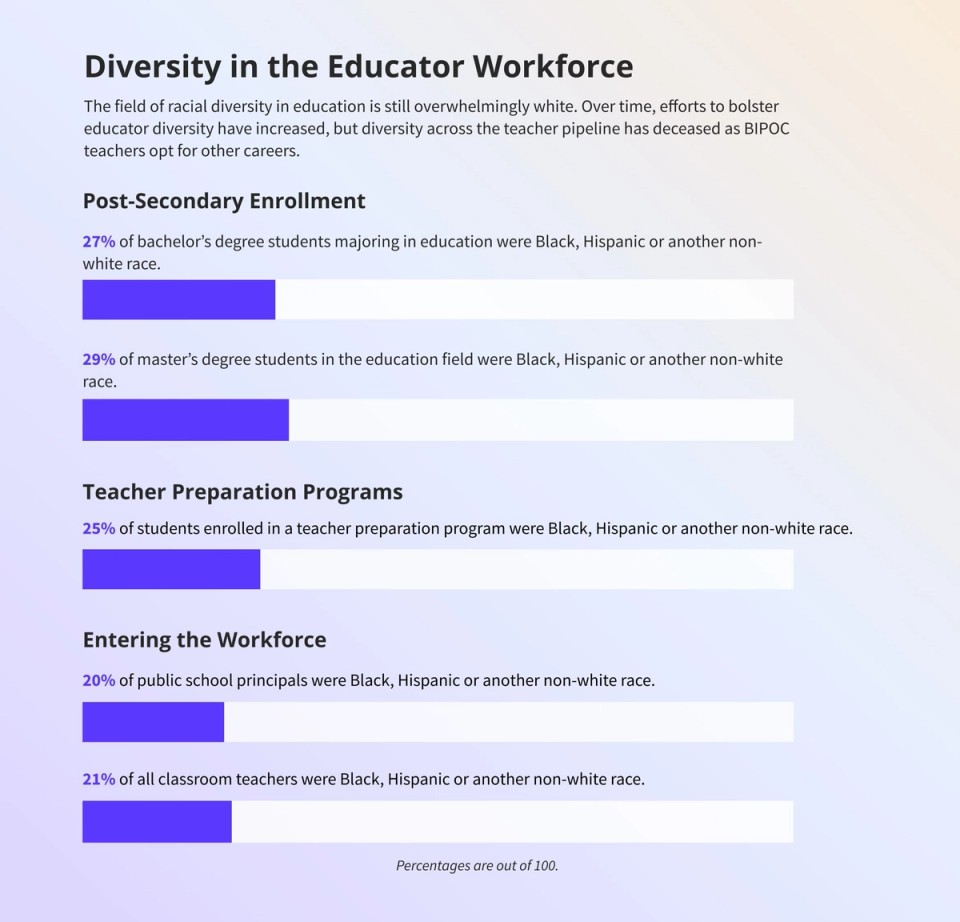
Students pursuing a bachelor’s degree in education—the main entry into the teaching profession—are also overwhelmingly white, according to Digital Promise's Pipeline and Retention of Teachers of Color report (PDF, 242KB). Additionally, students with significant debt from college loans are less likely to choose teaching or other low-paying professions.
Teachers of color often experience financial burden when entering the profession. Many BIPOC teachers come from families who do not have the financial means to make up for low teacher salaries, according to a TeachPlus report about why teachers of color leave the profession (PDF, 12.2MB). Some BIPOC teachers are still expected to help financially provide for their families of origin, which can also drive high turnover rates.
Roughly 19% of teachers of color either move schools or leave the profession annually (PDF, 460 KB), the Learning Policy Institute reported.
BIPOC teachers are leaving the profession more quickly than their white peers. Some choose to leave because they feel they are being pigeonholed into roles due to race, such as acting as a disciplinarian or counselor. Teachers of color often feel pressure to represent the needs of students of color while their ideas of innovating curriculum can sometimes be dismissed. They may also be evaluated more harshly than white teachers, causing them to feel undervalued and unappreciated.
Percentage of teachers who left their school after one year between the 2011-12 and 2012-13 school years, according to the U.S. Department of Education report:
of Black teachers
of Hispanic teachers
of white teachers
According to the Learning Policy Institute report, other challenges that drive high turnover rates include:
As one of the few Black teachers in her previous school, Miller was open and receptive to students and teachers leaning on her for advice on Black issues. At the same time, it was hard for her to be the main person carrying the emotional labor because she felt other teachers were not as involved in sharing that responsibility.
“It furthered the divide because Black teachers did Black things, and the other teachers were able to wash their hands of anything of that nature,” Miller said.
BIPOC teachers positively impact students in ways that benefit them long after they leave the classroom. According to the Learning Policy Institute’s report on diversity in the teaching profession, here are some of the benefits of having teachers of color:
“Students do feel less pressure talking to me,” Miller said. “They look at me and see a sister, an aunt or a mom. I can see these kids are going through hard stuff just to sit here every day, and I don’t know if they would have been comfortable to share that with anyone else.”
According to a Brookings Institution report on teacher diversity, the way Black male students perceived their teacher’s ability to control the classroom shifted when they had a teacher who looked like them. Those students also described how orderly and productive the classroom felt while teachers wasted less time disciplining students.
Representation in education matters. For many students of color, seeing BIPOC teachers can help them realistically consider different professions and open their minds.
“When I was in school, my guidance counselors saw my math skills and told me to become a math teacher. But why didn’t anyone tell me I could have been a statistician or an engineer? I would have loved to work for NASA,” Miller said.
“I wanted to open my students’ minds so they could see themselves in different professions other than athletes, entertainers, or store and gig workers. They see themselves in me—like if she could be a teacher, then I could be one one day, too.”
School staff, parents of students, education leaders and other teachers can make a difference at their schools by supporting teachers of color. Miller eventually left the teaching profession due to a combination of lack of pay, respect and parental and administrative support. She offers up these suggestions to support BIPOC teachers:
Supporting teachers can be similar to the way teachers already know how to support students. They can build empowering environments by acknowledging others' needs and creating safe spaces to express them. When Miller was a teacher, she pasted a rainbow-colored “Safe Space” decal on her classroom door.
“The students [who] see this know what it means. The ones who are meant to notice it feel safe here. Even if students weren’t fine, they could walk by and smile or wink, just nod like, ‘You see me.’ That’s the way I want teachers of color to feel. It's a mindset and cultural shift,” Miller said.
Diversity in the Educator Workforce
The following section contains tabular data from the graphics in this post.
Information last updated: July 2026